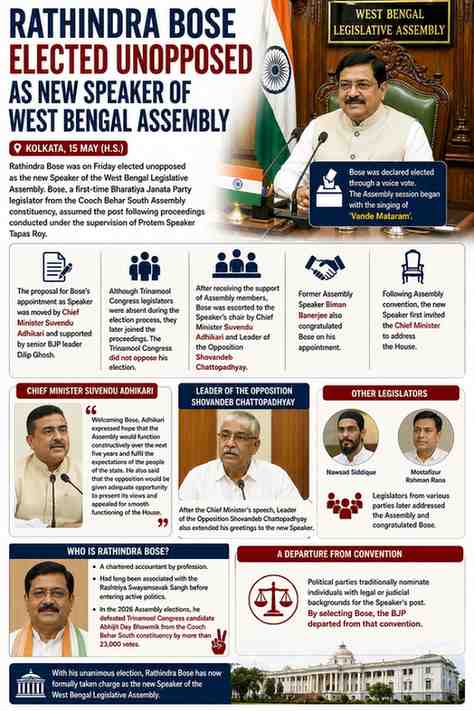
BJP MLA Rathindra Bose has been elected unopposed as the new Speaker of the West Bengal Legislative Assembly during the first session of the newly formed House.
Rathindra Bose was on Friday elected unopposed as the new Speaker of the West Bengal Legislative Assembly during the inaugural proceedings of the newly constituted House.
The election marked a significant political moment for the newly formed BJP-led government in West Bengal, as a first-time Bharatiya Janata Party legislator formally assumed one of the most important constitutional positions in the state legislature.
The proceedings were conducted under the supervision of Protem Speaker Tapas Roy.
The proposal nominating Bose for the Speaker’s post was moved by Chief Minister Suvendu Adhikari and supported by senior BJP leader Dilip Ghosh.
Following a voice vote in the Assembly, Bose was officially declared elected without opposition.
Assembly Session Begins with ‘Vande Mataram’
The inaugural Assembly session began with the singing of ‘Vande Mataram’, setting the tone for the first formal proceedings of the newly elected House after the 2026 Assembly elections.
Legislators from the ruling BJP and other political parties attended the session amid heightened political attention surrounding the formation of the new government and the beginning of legislative activities.
Although members of the All India Trinamool Congress were absent during the Speaker election process, they later joined the Assembly proceedings after Bose’s election had been completed.
Political observers viewed the absence of Trinamool legislators during the voting stage as symbolically significant, though the party ultimately did not oppose Bose’s appointment.
Chief Minister Escorts New Speaker to Chair
Following parliamentary convention, Rathindra Bose was escorted to the Speaker’s chair by Chief Minister Suvendu Adhikari and Leader of the Opposition Shovandeb Chattopadhyay.
The gesture reflected the Assembly tradition of ensuring a smooth and dignified transition for the newly elected Speaker regardless of political affiliations.
Former Assembly Speaker Biman Banerjee also congratulated Bose after the election results were announced.
Several legislators from different parties later greeted the new Speaker and wished him success in conducting the proceedings of the House.
Suvendu Adhikari Calls for Constructive Assembly Functioning
After assuming office, the newly elected Speaker invited Chief Minister Suvendu Adhikari to address the House in accordance with legislative convention.
In his speech, Adhikari expressed confidence that the Assembly would function constructively during the next five years and meet the expectations of the people of West Bengal.
The Chief Minister also stressed the importance of democratic debate and assured the opposition that adequate opportunities would be provided to raise issues and present its views in the House.
He appealed to all parties to cooperate in maintaining smooth legislative functioning and ensuring productive discussions on matters concerning governance and public welfare.
Political analysts noted that Adhikari’s remarks were aimed at projecting an image of stability and inclusiveness at the start of the BJP government’s tenure in the state.
Opposition Leaders Extend Greetings
Leader of the Opposition Shovandeb Chattopadhyay also addressed the Assembly after the Chief Minister’s speech and extended greetings to Rathindra Bose on behalf of the opposition benches.
Legislators from different political parties subsequently participated in the proceedings and congratulated the new Speaker.
Among those who addressed the House were Nawsad Siddique and Mostafizur Rahman Rana, both of whom wished Bose success in his new constitutional role.
The exchanges reflected the customary legislative practice of bipartisan goodwill during the election of a Speaker.
First-Time MLA from Cooch Behar South
Rathindra Bose entered the West Bengal Assembly for the first time after winning the 2026 Assembly election from the Cooch Behar South constituency.
The BJP candidate defeated Trinamool Congress nominee Abhijit Dey Bhowmik by a margin of more than 23,000 votes.
His victory was regarded as politically significant because Cooch Behar has emerged as an important electoral battleground in recent years.
Bose’s elevation to the Speaker’s post within days of entering the Assembly has therefore drawn considerable political attention across the state.
Observers noted that the BJP leadership’s decision to appoint a first-time legislator to such a key constitutional role reflects the party’s confidence in his organisational and ideological background.
Long Association with RSS
Before entering active electoral politics, Rathindra Bose had long been associated with the Rashtriya Swayamsevak Sangh (RSS).
Party leaders familiar with his background described him as an organisationally disciplined figure with extensive grassroots involvement.
Bose is also professionally trained as a chartered accountant, giving him a background distinct from many previous Speakers of the Assembly.
Political analysts noted that his organisational experience and administrative understanding likely influenced the BJP leadership’s decision to nominate him for the constitutional position.
BJP Breaks Tradition in Speaker Selection
Traditionally, political parties in several state legislatures often nominate senior advocates, experienced legislators or individuals with legal and judicial backgrounds for the Speaker’s post.
By selecting Rathindra Bose, the BJP departed from that long-standing convention in West Bengal politics.
Observers believe the move signals the BJP leadership’s preference for organisational loyalty and ideological commitment alongside parliamentary functioning.
The decision has also generated discussions regarding how Bose may shape legislative proceedings in a politically charged Assembly environment over the coming years.
Supporters of the ruling party argued that professional expertise and organisational experience are equally valuable qualifications for presiding over legislative business.
Significance of Speaker’s Role
The Speaker of a Legislative Assembly occupies one of the most important constitutional positions within India’s parliamentary framework.
The Speaker is responsible for conducting Assembly proceedings, maintaining order in the House and ensuring adherence to legislative rules and procedures.
The office also plays a critical role in deciding procedural disputes, recognising members during debates and safeguarding the functioning of democratic institutions within the legislature.
Political experts noted that Bose will face the challenging task of managing debates in a politically polarised Assembly where confrontations between the treasury benches and opposition are expected to remain intense.
Given the historic political transition in West Bengal following the BJP’s victory, the functioning of the Assembly under the new Speaker will be watched closely by political observers.
Political Transition in West Bengal
The election of Rathindra Bose as Speaker comes shortly after the BJP formed its first-ever government in West Bengal following the 2026 Assembly elections.
The political change marked a historic shift in the state’s electoral landscape after decades dominated by regional and Left parties.
Chief Minister Suvendu Adhikari has repeatedly stated that his administration intends to focus on governance reforms, institutional rebuilding and administrative restructuring.
The Assembly’s first session is therefore being viewed as an important indicator of how the new government intends to manage legislative affairs and political opposition.
Observers believe the Speaker’s conduct during future Assembly sessions will significantly influence the political atmosphere within the House.
Expectations from the New Speaker
Political leaders from across party lines expressed hope that Rathindra Bose would conduct proceedings fairly and uphold democratic traditions in the Assembly.
Legislators stressed the importance of impartiality, procedural integrity and equal opportunity for debate within the House.
Supporters of the ruling BJP described Bose as disciplined, calm and capable of handling complex legislative responsibilities.
Meanwhile, opposition parties indicated that they would closely monitor how the Speaker manages debates, disruptions and procedural issues during upcoming sessions.
As West Bengal enters a new political phase under BJP rule, Bose’s tenure as Speaker is expected to play a key role in shaping the functioning of the Assembly over the next five years.
With his unanimous election now complete, Rathindra Bose has formally assumed charge as the constitutional head of the West Bengal Legislative Assembly, beginning a politically significant chapter in the state’s legislative history.
Key Insights
- The unanimous election of Rathindra Bose as Speaker of the West Bengal Legislative Assembly reflects a procedural consensus-driven outcome, even amid broader political competition between major parties in the state.
- The absence of opposition during the formal voting process, followed by participation in subsequent proceedings, indicates an attempt to maintain institutional continuity and legislative decorum despite partisan differences.
- The Speaker’s role is constitutionally significant in ensuring the smooth functioning of the Assembly, particularly in managing debates, maintaining order, and upholding legislative procedures in a politically active state like West Bengal.
- The appointment of a first-time legislator with a professional background in chartered accountancy highlights a departure from the traditional preference for legal or long-experienced parliamentary figures in such constitutional positions.
- Cross-party congratulations and participation in the House proceedings suggest an early effort to project bipartisan cooperation, which can be important for legislative productivity over the tenure of the Assembly.
- The procedural conduct, including voice vote election and formal nomination support, underscores adherence to Assembly conventions despite political rivalry between major state parties.
- The Speaker’s neutrality will be closely watched, as the effectiveness of legislative functioning often depends on the ability of the presiding officer to balance competing party interests, especially during contentious debates and policy discussions.
- The development also reflects the evolving nature of legislative leadership selection in Indian states, where political, organisational, and electoral considerations increasingly influence appointments beyond traditional institutional norms.
Inputs & Images: Hindusthan Samachar
Edited By: Akshaya Polepalli
Also Read: Dr Vedprakash Mishra Appointed Head of National Experts Panel by National Medical Commission
Follow us on google news: Click Here